Currency
|

Determine your Raspberry Pi's precise position and orientation with the SparkFun LG580P GNSS Flex pHAT. This all-in-one development board is engineered for advanced navigation applications, combining our versatile pHAT carrier with the powerful LG580P module to deliver both centimeter-accurate RTK and real-time heading data. It's the ideal solution for intelligent robots, precision agriculture, and autonomous vehicle projects.
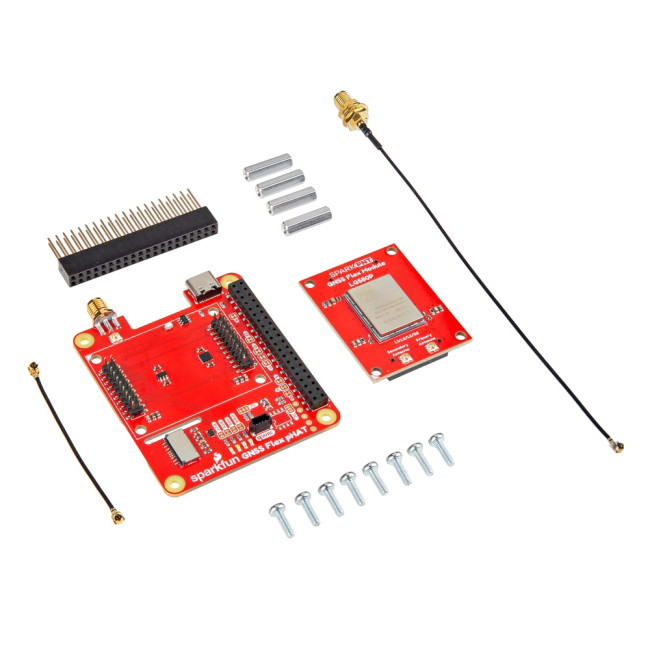
The GNSS Flex pHAT acts as the bridge between your single-board computer (SBC) and the modular SparkPNT ecosystem. It mounts securely via an extended 40-pin header and connects to the included GNSS module using standardized 2x10-pin headers, making it simple to swap modules for future upgrades. This kit includes all the necessary standoffs, screws, and an extended header for a clean, stable setup.
At the heart of this pHAT is the LG580P, a high-performance receiver that provides a complete navigation solution for dynamic applications.
L1, L2, L5, and L6/E6 bands across all major constellations (GPS, GLONASS, Galileo, BDS, QZSS, and NavIC) for fast convergence and performance even in challenging scenarios like urban canyons or deep tree cover.With an update rate of up to 20 Hz for both position and heading, the LG580P is ideal for high-speed robotics and vehicle control systems. Its versatility is further enhanced by broad support for standard RTK/RTCM corrections, a wide range of SBAS augmentation systems (WAAS, EGNOS, BDSBAS, MSAS, GAGAN, KASS, ASECNA, SouthPAN, and SDCM), and PPP services* (BDS PPP-B2b, QZSS CLAS, MADOCA-PPP, and Galileo HAS*).
This product requires external antennas for operation. Users have a few options for connecting an external GNSS antenna to their GNSS receiver.
This pHAT also requires a Raspberry Pi (or similar single-board computer). Users can find Raspberry Pi and NVIDIA single-board computers in our catalog. By default, we use the Raspberry Pi's primary serial bus (i.e., TX: GPIO14/Pin 8; RX: GPIO15/Pin 9) to communicate with the GNSS receiver. However, users can also utilize any of the other interfaces.
*According to Quectel, support for the I²C interface is still under development and will be made available through a future firmware update. Additionally, the corrections for some of the PPP services (like HAS E6) have not been implemented yet.
| Manufacturer | SparkFun |
|---|