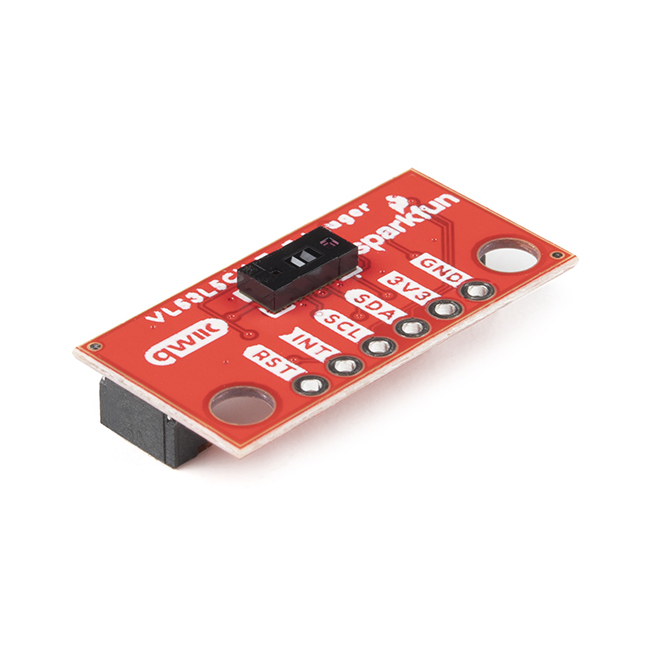
The SparkFun Qwiic Mini ToF Imager packs the incredible 3D sensing capabilities of the VL53L5CX into a footprint half the size of our standard board. Measuring just 0.5-inch x 1-inch, this board is designed specifically for tight spaces and sleek enclosures. It integrates the same SPAD array and...
The SparkFun Qwiic Mini ToF Imager packs the incredible 3D sensing capabilities of the VL53L5CX into a footprint half the size of our standard board. Measuring just 0.5-inch x 1-inch, this board is designed specifically for tight spaces and sleek enclosures. It integrates the same SPAD array and optical elements as its bigger brother, delivering a 64-pixel (8x8) depth map that gives your project true vision capabilities rather than just a simple distance number.
Designed for Enclosures
We redesigned the layout to make mounting easier than ever. Unlike standard breakouts, we placed the Qwiic connectors on the back in a vertical orientation.
Flush Mounting: This allows you to mount the sensor flush against the wall of a chassis or enclosure—facing outward—while keeping your cables tucked cleanly away behind it.
Clean Look: It is the ideal form factor for robotics "eyes," user presence detection systems, or gesture control panels, where you don't want wires protruding from the sides.
Multizone Ranging & Algorithms
Despite its tiny size, it sacrifices nothing in performance compared to the larger board:
Wide Vision: Covers a 63° diagonal Field-of-View, measuring distance to 64 separate zones simultaneously
Long Range: Capable of measuring distances up to 4000mm (4 meters) across all zones at speeds up to 15Hz.
Smart Detection: Thanks to ST's patented Histogram algorithms, the sensor can detect multiple objects within the Field-of-View and provides immunity to crosstalk from cover glass (beyond 60cm).
Controller Compatibility
This Qwiic Mini VL53L5CX ToF Imager is highly advanced, and with that power comes a specific requirement: it must load its firmware (~90KB) over the I2C bus every time it powers on. This means standard 8-bit microcontrollers like the Arduino Uno do not have enough flash memory to handle this sensor. To use this imager, you will need a more capable board with sufficient memory, such as the SparkFun Artemis, an ESP32-equipped board, or a Raspberry Pi RP2040/RP2350 board.