Currency
|

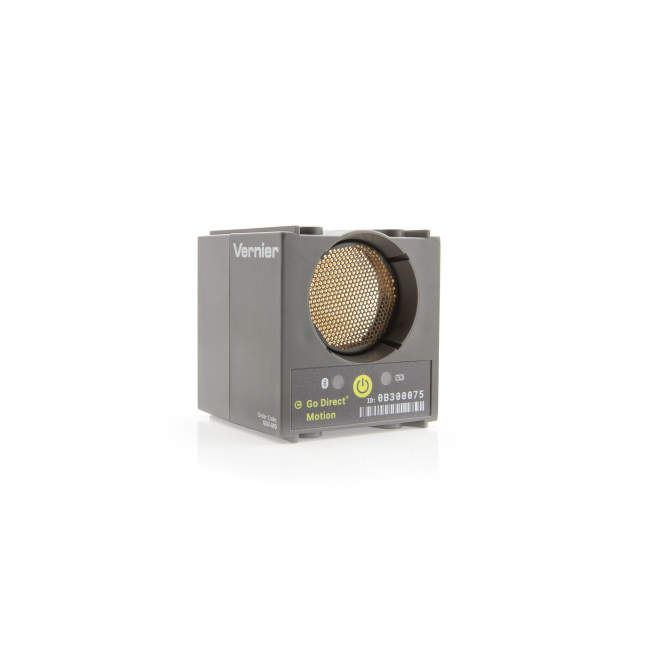
The Go Direct Motion Detector accurately tracks objects as close as 15 cm and as far away as 3.5 m. The compact design and wireless capability of this motion detector eliminate the concern of a dangling cable getting in the way.
The Go Direct Motion Detector accurately tracks objects as close as 15 cm and as far away as 3.5 m. The compact design and wireless capability of this motion detector eliminate the concern of a dangling cable getting in the way.
The Go Direct Motion Detector can be used in a variety of experiments:
The robust rechargeable battery offers long battery life and provides always-ready operation when using the sensor wirelessly. Monitor battery life directly from our award-winning Vernier Graphical Analysis® app, as well as LabQuest® 3. Should the battery run low, simply connect the sensor to the charging cable and keep on collecting—no interruptions or inconvenience to you or your students.
Our Go Direct sensors connect directly to your mobile device, Chromebook™, or computer using our Vernier Graphical Analysis® app—no additional equipment or software purchases are necessary. Go Direct sensors can be used wired via USB or wirelessly via Bluetooth® wireless technology, allowing you to choose the best solution for your classroom or laboratory.
Using the Go Direct® Motion Detector
Elementary School (14 experiments)
| Experiment | Lab Book |
|---|---|
| Learning to Use a Motion Detector | Investigating Motion |
| e-Motion! | Investigating Motion |
| Spring into Action | Investigating Motion |
| Air Ball! | Investigating Motion |
| Driving with Energy | Investigating Motion |
| Weigh Station—All Trucks Stop! | Investigating Motion |
| Batty About Science | Investigating Motion |
| Learning to Use Go! Motion | Elementary Science with Vernier |
| e-Motion | Elementary Science with Vernier |
| Batty About Science | Elementary Science with Vernier |
| Spring into Action! | Elementary Science with Vernier |
| Air Ball! | Elementary Science with Vernier |
| Driving with Energy | Elementary Science with Vernier |
| Weigh Station - All Trucks Stop! | Elementary Science with Vernier |
Middle School (24 experiments)
| Experiment | Lab Book |
|---|---|
| Mapping the Ocean Floor | Earth Science with Vernier |
| Hit and Run | Forensics with Vernier |
| Bouncing Back | Forensics with Vernier |
| Speeding Up | Forensics with Vernier |
| Ocean Floor Mapping | Exploring Earth and Space Science |
| Graphing Your Motion | Exploring Physical Science |
| Speeding Up | Exploring Physical Science |
| The Indy 100/Pencil Car | Exploring Physical Science |
| Crash Dummies | Exploring Physical Science |
| Falling Objects | Exploring Physical Science |
| A Speedy Slide | Exploring Physical Science |
| Ocean Floor Mapping | Middle School Science with Vernier |
| Graphing Your Motion | Middle School Science with Vernier |
| Speeding Up | Middle School Science with Vernier |
| The Indy 100 | Middle School Science with Vernier |
| Crash Dummies | Middle School Science with Vernier |
| Falling Objects | Middle School Science with Vernier |
| A Speedy Slide | Middle School Science with Vernier |
| Graphing Your Motion | Physical Science with Vernier |
| Speeding Up | Physical Science with Vernier |
| It's Race Day | Physical Science with Vernier |
| Crash Lesson | Physical Science with Vernier |
| Newton's Second Law | Physical Science with Vernier |
| Falling Objects | Physical Science with Vernier |
High School (42 experiments)
| Experiment | Lab Book |
|---|---|
| Mapping the Ocean Floor | Earth Science with Vernier |
| Hit and Run | Forensics with Vernier |
| Bouncing Back | Forensics with Vernier |
| Speeding Up | Forensics with Vernier |
| Springs Making Things Move | Physics Explorations and Projects |
| Kinetic Energy and Mass | Physics Explorations and Projects |
| Work and Kinetic Energy | Physics Explorations and Projects |
| Work Done by Gravity | Physics Explorations and Projects |
| Energy in Collisions | Physics Explorations and Projects |
| Constant Motion and Changing Motion | Physics Explorations and Projects |
| Balanced Forces and Unbalanced Forces | Physics Explorations and Projects |
| Oscillations | Physics Explorations and Projects |
| Heat as Energy Transfer | Physics Explorations and Projects |
| Newton’s Second Law | Physics Explorations and Projects |
| Impulse and Momentum | Physics Explorations and Projects |
| Equilibrium of Forces | Physics Explorations and Projects |
| Conservation of Momentum | Physics Explorations and Projects |
| Impulse and Momentum | Advanced Physics with Vernier — Mechanics |
| Momentum and Collisions | Advanced Physics with Vernier — Mechanics |
| The Mathematical Model of Simple Harmonic Motion | Advanced Physics with Vernier — Mechanics |
| Kinematics and Dynamics of Simple Harmonic Motion | Advanced Physics with Vernier — Mechanics |
| Motion on an Incline | Advanced Physics with Vernier — Mechanics |
| Newton's First Law | Advanced Physics with Vernier — Mechanics |
| Newton's Second Law | Advanced Physics with Vernier — Mechanics |
| Energy Storage and Transfer: Kinetic Energy | Advanced Physics with Vernier — Mechanics |
| Energy Storage and Transfer: Gravitational Energy | Advanced Physics with Vernier — Mechanics |
| Graphing Your Motion | Physical Science with Vernier |
| Speeding Up | Physical Science with Vernier |
| It's Race Day | Physical Science with Vernier |
| Crash Lesson | Physical Science with Vernier |
| Newton's Second Law | Physical Science with Vernier |
| Falling Objects | Physical Science with Vernier |
| Static and Kinetic Friction | Physics with Vernier |
| Air Resistance | Physics with Vernier |
| Simple Harmonic Motion | Physics with Vernier |
| Energy of a Tossed Ball | Physics with Vernier |
| Energy in Simple Harmonic Motion | Physics with Vernier |
| Graph Matching | Physics with Vernier |
| Back and Forth Motion | Physics with Vernier |
| Cart on a Ramp | Physics with Vernier |
| Determining g on an Incline | Physics with Vernier |
| Ball Toss | Physics with Vernier |
College (32 experiments)
| Experiment | Lab Book |
|---|---|
| Springs Making Things Move | Physics Explorations and Projects |
| Kinetic Energy and Mass | Physics Explorations and Projects |
| Work and Kinetic Energy | Physics Explorations and Projects |
| Work Done by Gravity | Physics Explorations and Projects |
| Energy in Collisions | Physics Explorations and Projects |
| Constant Motion and Changing Motion | Physics Explorations and Projects |
| Balanced Forces and Unbalanced Forces | Physics Explorations and Projects |
| Oscillations | Physics Explorations and Projects |
| Heat as Energy Transfer | Physics Explorations and Projects |
| Newton’s Second Law | Physics Explorations and Projects |
| Impulse and Momentum | Physics Explorations and Projects |
| Equilibrium of Forces | Physics Explorations and Projects |
| Conservation of Momentum | Physics Explorations and Projects |
| Impulse and Momentum | Advanced Physics with Vernier — Mechanics |
| Momentum and Collisions | Advanced Physics with Vernier — Mechanics |
| The Mathematical Model of Simple Harmonic Motion | Advanced Physics with Vernier — Mechanics |
| Kinematics and Dynamics of Simple Harmonic Motion | Advanced Physics with Vernier — Mechanics |
| Motion on an Incline | Advanced Physics with Vernier — Mechanics |
| Newton's First Law | Advanced Physics with Vernier — Mechanics |
| Newton's Second Law | Advanced Physics with Vernier — Mechanics |
| Energy Storage and Transfer: Kinetic Energy | Advanced Physics with Vernier — Mechanics |
| Energy Storage and Transfer: Gravitational Energy | Advanced Physics with Vernier — Mechanics |
| Static and Kinetic Friction | Physics with Vernier |
| Air Resistance | Physics with Vernier |
| Simple Harmonic Motion | Physics with Vernier |
| Energy of a Tossed Ball | Physics with Vernier |
| Energy in Simple Harmonic Motion | Physics with Vernier |
| Graph Matching | Physics with Vernier |
| Back and Forth Motion | Physics with Vernier |
| Cart on a Ramp | Physics with Vernier |
| Determining g on an Incline | Physics with Vernier |
| Ball Toss | Physics with Vernier |
Choose a platform below to see its compatibility requirements.
LabQuest
| Interface | LabQuest App |
|---|---|
| LabQuest 3 | Full support |
| LabQuest 2 | Full support 1 |
| LabQuest | Incompatible |
Computers
| Software | ||
|---|---|---|
| Interface | Graphical Analysis | Graphical Analysis (Web App) |
| No interface required | Full support | Full support |
| LabQuest 3 | Full support 1 | Incompatible |
| LabQuest 2 | Full support 1 2 | Incompatible |
Chromebook
| Software | |
|---|---|
| Interface | Graphical Analysis (Web App) |
| No interface required | Full support |
iOS
| Software | ||
|---|---|---|
| Interface | Graphical Analysis | Graphical Analysis GW |
| No interface required | Full support | Full support |
| LabQuest 3 | Full support 1 2 | Full support 1 2 |
| LabQuest 2 | Full support 1 2 3 | Full support 1 2 3 |
Android
| Software | ||
|---|---|---|
| Interface | Graphical Analysis | Graphical Analysis GW |
| No interface required | Full support | Incompatible |
| LabQuest 3 | Full support 1 2 | Full support 1 |
| LabQuest 2 | Full support 1 2 3 | Full support 1 3 |
Python
| Software | |
|---|---|
| Interface | Python |
| No interface required | Full support |
Javascript
| Software | |
|---|---|
| Interface | Javascript |
| No interface required | Full support 1 |
Arduino
| Software | |
|---|---|
| Interface | Arduino |
| Arduino UNO R4 WiFi | Full support |
LabVIEW
| Software | |
|---|---|
| Interface | NI LabVIEW |
| No interface required | Full support |
Texas Instruments
| Software | |
|---|---|
| Interface | EasyData |
| No interface required | Full support 1 2 3 |
| Manufacturer | Vernier |
|---|