Currency
|

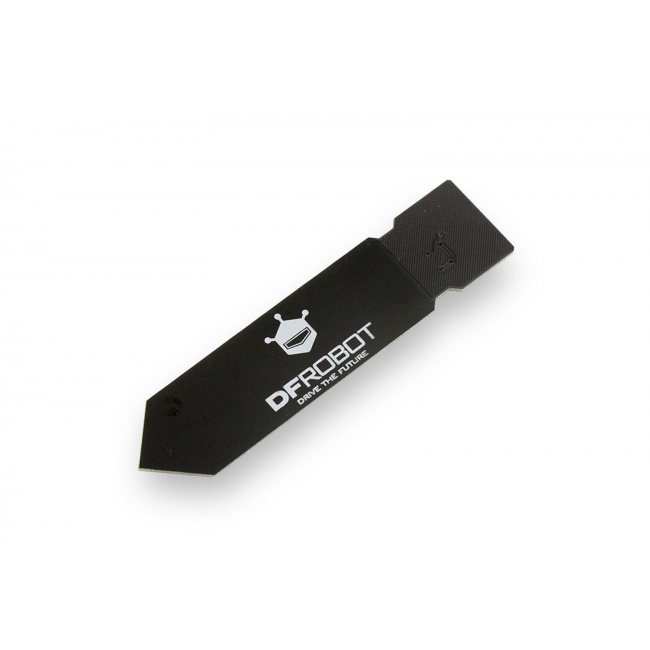
This Gravity capacitive soil moisture sensor helps turn changing soil conditions into a plant watering reminder, a moisture display, or a classroom experiment. Capacitive sensing and corrosion-resistant construction make this sensor a practical choice for observing moisture around indoor plants without relying on exposed resistive probes. A 3.3–5.5V supply range supports integration with suitable 3.3V and 5V controllers, including Arduino. The included analog cable and Gravity 3-pin interface simplify connection. Paired with a controller and project-specific output hardware, this soil moisture sensor provides an accessible starting point for indoor gardening and environmental science activities.
Capacitive Sensing with Corrosion-Resistant Construction
This soil moisture sensor uses capacitive sensing rather than measuring resistance through exposed conductive electrodes. The corrosion-resistant design addresses a common durability concern in resistive soil probes, making this sensor useful for repeated plant monitoring and gardening experiments. The detection area can be inserted into moist soil, while the upper board components must stay dry. This construction supports ongoing moisture observations without treating the entire sensor as a fully waterproof probe.
Gravity Connection for 3.3V and 5V Controllers
This analog soil moisture sensor operates from a 3.3–5.5V supply and uses a PH2.0-3P Gravity connector for power, ground, and signal. The included analog sensor cable connects to a compatible Gravity I/O Expansion Shield, reducing wiring work during assembly. A suitable analog input lets a controller read the moisture-related signal; Raspberry Pi projects require an external ADC. This arrangement keeps the sensing hardware simple while allowing different display and notification designs.
From Moisture Readings to Watering Reminders
This soil moisture sensor provides an analog signal that a controller can use to compare soil conditions and trigger project-defined responses. Arduino calibration and detection examples show how to establish dry and wet reference readings before classifying moisture conditions. With additional LEDs, a buzzer, a display, or communication hardware, this sensor can become a watering reminder or data logging project, helping connect plant-care observations with programming and electronics.
For more detailed insights on selecting the most suitable sensor, refer to the guide on [How to Select the Best Soil Moisture Sensors for Agriculture and Research Lab].
The following image shows an example project - a device that notifies you when a plant needs to be watered.
Hardware Components:
Particle Photon Project 2: Annoying Soil Moisture Sensor with Photon and IFTTT Project
Never forget to water your plants again with this super annoying project. It combines visual, auditory, and textual cues that will prevent you from doing anything else until you provide your plant with much-needed hydration. A piezo buzzer constantly blares a shrill note, while a super-bright LED annoys your peripheral vision. In addition, this project will send constant texts to your phone reminding you that your plant needs to be watered. Sounds like fun, right?
Hardware Components:
Project 3: OBLOQ-IoT Module +Micro:bit IoT Flower Watering
Hardware Components:
| Manufacturer | DFRobot |
|---|