Currency
|

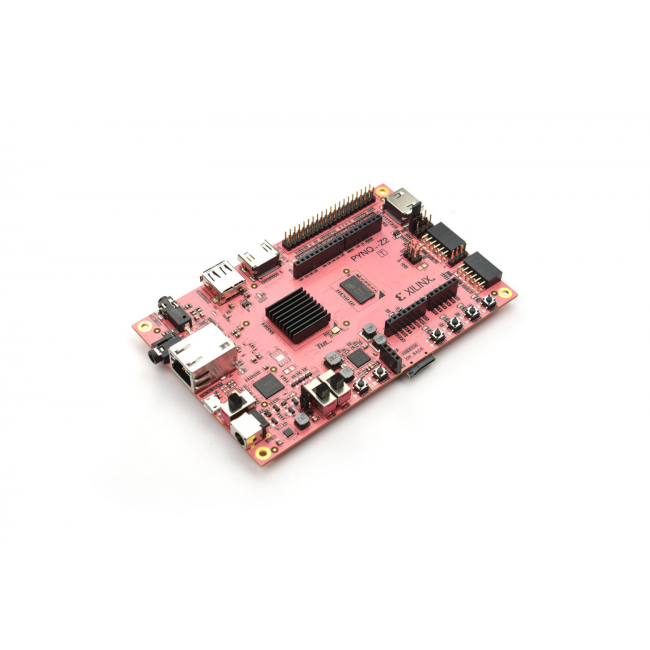
This PYNQ-Z2 development board brings Python programming and FPGA hardware together for embedded-system learning and prototyping. The Zynq XC7Z020 combines a dual-core Cortex-A9 processor with programmable logic, allowing software to control compatible hardware libraries through Python APIs. Start with existing PYNQ overlays to explore board peripherals and hardware-backed functions, then progress toward custom designs as project needs grow. With 512MB DDR3, Gigabit Ethernet, HDMI input/output and audio interfaces, this board supports hands-on work across sensing, signal processing and multimedia. The package includes the development board; prepare the boot media, power connection and project peripherals separately.
Python Access to Existing FPGA Hardware Overlays
PYNQ makes compatible programmable-logic designs available as hardware libraries called overlays, which Python code can load and control through APIs. This gives software-oriented developers a route into FPGA experiments using existing designs, without creating logic circuits for every first project. The PYNQ environment supports developing and testing Python code on the board, with example notebooks for supported peripherals. Building a new custom overlay still requires the appropriate FPGA design and implementation workflow.
ARM Processing and Programmable Logic on One Platform
This Zynq development board combines a listed 650MHz dual-core Cortex-A9 processor with programmable logic equivalent to an Artix-7 FPGA. The hardware resources include 13,300 logic slices, 630 KB of block RAM and 220 DSP slices, alongside 512MB DDR3 memory. This architecture supports exploring how work can be divided between software and parallel hardware. Application speed depends on the implemented overlay and data path, making this board a platform for acceleration development rather than a fixed-performance accelerator.
HDMI and Audio for Multimedia Experiments
This PYNQ-Z2 board integrates HDMI input and output, an audio interface with a 3.5mm TRRS jack, and a separate line-in jack. These connections support practical video and audio experiments using a suitable overlay, while Gigabit Ethernet provides network access to the development environment. The documented base overlay includes support for HDMI and the audio codec, helping connect hardware inputs to Python-controlled processing. Compatible sources, displays and audio peripherals are additional project components.
Expansion Through Pmod and Familiar Connector Formats
Two Pmod ports, an Arduino shield connector and a Raspberry Pi connector extend the board to compatible sensors and peripherals. Four push-buttons, two switches, four LEDs and two RGB LEDs provide onboard interaction for introductory experiments. Expansion pins connect to programmable logic, so the selected overlay must support the required interfaces. Eight Pmod A pins are shared with the Raspberry Pi connector; plan pin usage and check electrical compatibility before combining expansion hardware.
Development and Expansion Notes
| Manufacturer | DFRobot |
|---|