Currency
|

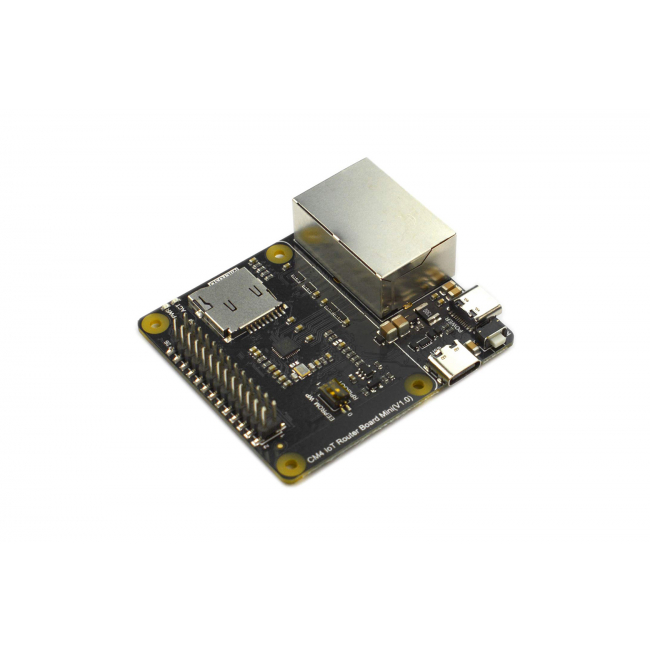
This dual-Gigabit router carrier board turns a Raspberry Pi Compute Module 4 into a compact foundation for an OpenWrt router, IoT gateway or home networking project. Two Gigabit Ethernet ports combine the CM4's native network interface with a PCIe-connected network controller, keeping both wired connections on one 55x62mm board. A 26-pin GPIO header and USB 2.0 interface extend the build beyond routing to sensors, actuators and compatible peripherals. OpenWrt, Raspberry Pi OS and Ubuntu Server support offer flexibility for network and IoT applications. A Raspberry Pi Compute Module 4 is required and purchased separately.
Dual Gigabit Ethernet with a PCIe Network Interface
This CM4 carrier board provides two wired Gigabit Ethernet connections: ETH1 uses the Compute Module 4's built-in interface, while ETH2 uses a PCI Express 1000BASE-T NIC. This arrangement provides a compact starting point for separating upstream and downstream network connections in a router build. The second network connection uses PCIe rather than a USB Ethernet adapter, leaving the USB 2.0 data interface available for other peripherals. Gigabit port capability describes the interfaces; actual routing throughput depends on the complete system.
OpenWrt Routing with Linux Software Flexibility
This IoT router carrier board supports the provided OpenWrt router system, allowing a CM4-based build to be configured for routing. Compatibility with Raspberry Pi OS, Ubuntu Server and other supported Raspberry Pi systems also opens a path to gateway and home IoT applications. Processing comes from the separately installed CM4 and its BCM2711 quad-core 1.5GHz Cortex-A72 processor. The carrier board supplies networking and expansion interfaces, while the selected operating system and configuration determine the finished system's functions.
55x62mm Form Factor with GPIO and USB Expansion
This compact carrier board retains a 26-pin Raspberry Pi-compatible GPIO header for connecting suitable sensors, actuators and cooling accessories. A USB-C data port provides USB 2.0 High Speed connectivity for compatible storage devices, printers, Wi-Fi adapters or LTE modules, while a separate USB-C port supplies power. The microSD slot supports CM4 modules without eMMC. These interfaces support customized builds in a small footprint, with USB-C 5V/3A power specified for the board.
Important:
Connect Diagram

Dimension
ETH1: Compute Module 4 Built-In
ETH2: PCI Express 1000BASE-T NIC
1x USB-C: Power only
1x USB-C: USB 2.0 High Speed
| Manufacturer | DFRobot |
|---|