Currency
|

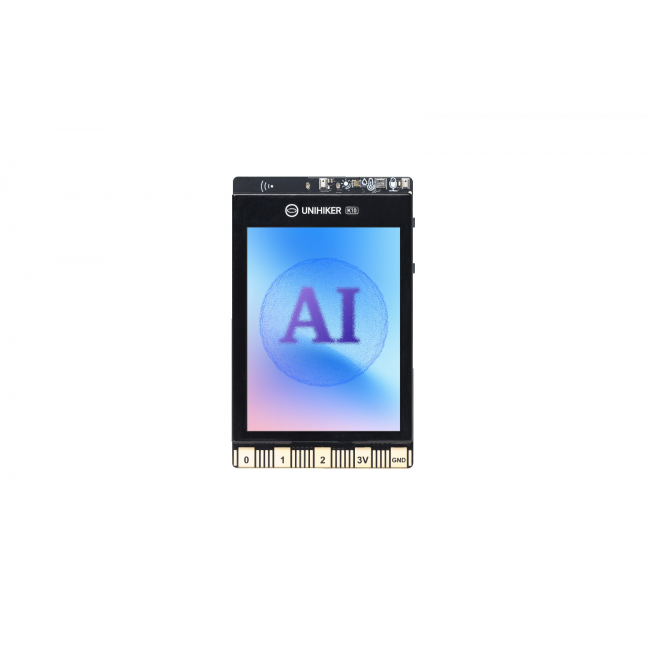
UNIHIKER K10 is an ESP32-S3-based AI coding board for STEM learning and maker projects. A 2.8-inch color display, 2MP camera, microphone, speaker, RGB lights and onboard sensors provide input and feedback without connecting separate modules for basic projects.
UNIHIKER K10 is an ESP32-S3-based AI coding board for STEM learning and maker projects. A 2.8-inch color display, 2MP camera, microphone, speaker, RGB lights and onboard sensors provide input and feedback without connecting separate modules for basic projects.
Begin with local face detection, voice commands and sensor interaction. Use graphical programming or code to connect recognition results to screen content, lights and sound, then progress to custom TinyML models or cloud-connected AI applications.
What Runs Locally, and What Needs a Connection?
Built-in Vision Functions for Beginner Projects
Ideal for first-time AI exploration, the UNIHIKER K10 board comes with four ready-to-use vision models: Face Detection, Pet Recognition (Cat/Dog), QR Code Scanning, and Motion Sensing. The integrated 2MP camera allows beginners to immediately create security systems, interactive displays, and smart monitoring projects - no prior programming experience needed.
Offline Voice Commands for Interactive Projects
Equipped with a built-in microphone and pre-installed voice models, the UNIHIKER K10 supports offline speech recognition. This enables users to create voice-activated applications, such as custom voice commands and interactive AI systems, without requiring an internet connection.
Use local speech recognition to detect configured command words and trigger programmed actions, such as changing the onboard RGB lights. The documented example uses “Hi, Telly” as a wake-up phrase and “Light on” / “Light off” as commands.
Command wording must follow the recognition engine’s requirements. Open-ended LLM conversation uses a separate cloud-connected workflow.
Not Just Built-in Models
The UNIHIKER K10 supports TinyML, allowing users to train their own custom vision and sensor models. With the ability to develop personalized AI models for specific tasks, users can explore deeper AI applications and tailor the board’s functionality to their unique projects. Whether working with image recognition, sensor data, or other AI-based tasks, TinyML offers the flexibility to push the boundaries of the board’s capabilities.
Combine BT & Wi-Fi with AI to Create More Possibilities
By combining Bluetooth 5.0 and Wi-Fi 2.4G with onboard AI functionality, the UNIHIKER K10 offers extensive connectivity options for creating more interactive and data-driven applications. Whether building IoT systems, remote control applications, or data transmission projects, the UNIHIKER K10 provides seamless integration of AI with wireless communication protocols.
Support the Internet of Things
The UNIHIKER K10 is designed with IoT applications in mind. It supports long-term data collection and remote monitoring, making it ideal for projects that require continuous data recording and analysis. With its rich set of sensors (temperature, humidity, light, accelerometer) and connectivity options (Wi-Fi, Bluetooth), users can easily integrate the UNIHIKER K10 into IoT ecosystems for real-time monitoring, remote device control, and data-driven applications.
Pair it with the Gravity: BME688 AI Environmental Sensor (VOC, Temperature, Humidity, Pressure) to create advanced air quality monitoring projects.
Built-in 2.8-inch Color Screen for Data Visualization
The UNIHIKER K10 features a 2.8-inch color screen that enables users to visualize real-time data from sensors, AI models, and projects. This screen is ideal for displaying sensor readings, AI outputs, and project results directly on the board, providing immediate feedback.
Rich Interfaces and High Expandability
With an array of I/O ports, including USB Type-C, MicroSD, Gravity 3pin/4pin, and edge connectors, the UNIHIKER K10 offers rich expandability for connecting additional sensors, actuators, and accessories.
Supports Graphical and MicroPython Programming
The UNIHIKER K10 supports both graphical programming and MicroPython, catering to users at different skill levels. It is also compatible with Mind+, a drag-and-drop programming tool that simplifies coding with blocks. The graphical programming interface allows beginners to quickly build projects without needing to write code, while MicroPython offers a more advanced programming environment for experienced developers.
The tool also offers a variety of sample projects to help users get started, such as:
For more hands-on tutorials, visit the Examples link to explore a wide range of projects.
Download Mind+ to get started: Mind+ Download.
Officially Supported by ESP-CLAW: Play with Your AI Agent
The UNIHIKER K10 delivers the "Command. Realize." workflow as an officially supported hardware platform for the ESP-CLAW framework. By simply flashing the firmware, the UNIHIKER K10 turns into an AI Agent, enabling the control of physical hardware using natural language via chat apps (like Telegram). Instead of manual coding, the AI Agent automatically calls tools, writes scripts, and executes them on the board. Acting as a powerful data pipeline for external APIs (via MCP), it seamlessly connects Cloud LLMs to physical sensors. The new released step-by-step tutorial are available to guide the firmware flashing process and initiate the AI Agent.
UNIHIKER Selection Guide
Video: Introduction and Feature Demonstration of UNIHIKER K10
| Manufacturer | DFRobot |
|---|